
|
|
|||||
|
|
|
|
|||
|
Lethal Intent -- by Sue Russell That rarest of serial killers - a woman - Aileen 'Lee' Wuornos always craved fame. Long before she was hunted and caught by Florida law enforcement, long before she confessed to killing seven men, she told friends that she wanted to do something "no woman has ever done before" and to have a book about her life. Lethal Intent reveals Aileen's devastating double abandonment by her mother before she was age two, the crimes of her father, and the myriad events that helped set her path of destruction. It even contests the widespread superficial judgment of Wuornos as a "man-hating lesbian" via new insights from men with whom she shared sexual and romantic relationships. Lethal Intent explores the dynamics of her fateful relationship with Tyria Moore, the lesbian lover who knew Aileen was killing yet stayed by her side, and how those dynamics moved Aileen closer to a life of murder. Lethal Intent contains new insights and intimate memories from her family, friends and childhood peers. (Peers who lost their virginities to Aileen, who began prostituting herself at a horribly early age.) |
Show and Tell: The
Baton Rouge Serial Killer (Take 2) Continued
from:
On July 9, 2002, the man attacked a 45-year-old Breaux Bridge woman in her home. He wore jeans and a white shirt, and drove a gold Mitsubishi Mirage. Although DNA testing of evidence was inconclusive, police believe the assaults are related to the serial killer investigation. The assailant talked his way into the victims’ homes, asking to use a telephone and phone book. He was described as friendly and non-threatening, a muscular, good-looking guy. Once inside, he made small talk, eliciting information about others who might live in the residence, or be expected to arrive there. When he determined the women were alone, and when he was reasonably assured he would not be interrupted, he attacked.
This sketch was submitted to the Task Force, but was not released. It quickly developed a cult following, however, surfacing on a few car windshields, and making a brief Internet appearance before being unceremoniously relegated to the trash heap of underappreciated visual aids. It is brought back by popular demand, and for your perusal. Should any of these exhibits strike your fancy, please do call one of the numbers below. LSU Police -- 225-578-3231 (Exhibit 3 only) Baton Rouge Multi-Agency Task Force -- 1-866-389-3310 (All others)
© John Philpin, 2003 All Rights Reserved -- Do not reproduce in any form or circulate without permission. News archives on the Baton Rouge Serial Killings More about Criminal Profiler and author John Philpin More about Serial Killers Kari & Associates Copyright Kari Sable 1994-2006 |
The Hillside Stranglers by Darcy O'Brien -- For weeks in the fall of 1977, as the body count of sexually violated, brutally murdered young women escalated, the Los Angeles news headlined the deeds of a serial killer they named the Hillside Strangler. But it would take more than another year and the mysterious disappearance of two young women in Seattle before the police would arrest one man-the handsome, charming, fast-talking Kenny Bianchi-and discover that the strangler was actually two men. O'Brien, an experienced investigator brings the story of Bianchi and his animally magnetic cousin Angelo Buono. First exploring the symbiotic relationship between these two men who shared a lust as insatiable as their hate for women, the crimes themselves and the lives of the victims. Perfect Poison --by M. William Phelps--In Northampton, Massachusetts, at the Veterans Affairs Medical Center, Kristen Gilbert was known as a dedicated nurse--so why were her patients dying? So many sudden deaths occurred while Kristen made her rounds that colleagues called her the "Angel of Death." Gilbert's facade concealed a manipulative liar and narcissistic sociopath. She sabotaged patients to strike back at staffers she didn't like. She engaged in an obsessive affair with hospital security guard, James Perrault. When her husband objected, she tried to kill him with a lethal injection. August 1995 - February 1996, helpless patients trusted her only to learn she was a killer, her weapon a drug capable of causing fatal heart attacks. Kristen Gilbert may have been responsible for as many as 40 deaths. As the law closed in, she struck back, faking suicide attempts, harassing witnesses, stalking her ex-boyfriend, and terrorizing the hospital with bomb threats.
|
 At a news
conference on the afternoon of Friday, May 23, 2003,
the Baton Rouge area Multi-Agency Task Force released a
sketch of a man suspected in assaults on three St. Martin Parish
women. The suspect is described as a clean-cut, light-skinned black
male in his late twenties to early thirties, with short black hair
and brown eyes.
At a news
conference on the afternoon of Friday, May 23, 2003,
the Baton Rouge area Multi-Agency Task Force released a
sketch of a man suspected in assaults on three St. Martin Parish
women. The suspect is described as a clean-cut, light-skinned black
male in his late twenties to early thirties, with short black hair
and brown eyes. 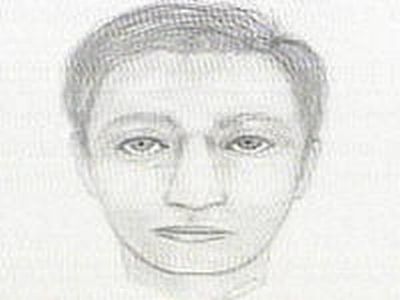 Following
the homicide of Trineisha Dene Colomb in December
2002, police released their first sketch. Waxing Ashcroftian,
Chief Pat Englade referred to the composite as a person of interest
(POI), that nebulous area that is neither suspect nor witness, but
hints at being more of the former. The sketch appears nearly human,
and quite possibly male. He was seen in a white truck near where
Colomb disappeared.
Following
the homicide of Trineisha Dene Colomb in December
2002, police released their first sketch. Waxing Ashcroftian,
Chief Pat Englade referred to the composite as a person of interest
(POI), that nebulous area that is neither suspect nor witness, but
hints at being more of the former. The sketch appears nearly human,
and quite possibly male. He was seen in a white truck near where
Colomb disappeared. Exhibit
three is the composite sketch of a black male suspected of two
armed robberies ten minutes apart in an LSU parking lot in the early
hours of September 14, 2002. No one was injured, and the man escaped
on foot. It is included here for three reasons. First, the incident
will serve as a lesson in less-than-rapid police response for the
next time a robber is holding you at gunpoint in an LSU parking
lot. Second, the sketch either resembles the St. Martin Parish suspect,
or it exposes hitherto unknown limitations in the software. And
third, if you know this man, the LSU police would like to hear from
you.
Exhibit
three is the composite sketch of a black male suspected of two
armed robberies ten minutes apart in an LSU parking lot in the early
hours of September 14, 2002. No one was injured, and the man escaped
on foot. It is included here for three reasons. First, the incident
will serve as a lesson in less-than-rapid police response for the
next time a robber is holding you at gunpoint in an LSU parking
lot. Second, the sketch either resembles the St. Martin Parish suspect,
or it exposes hitherto unknown limitations in the software. And
third, if you know this man, the LSU police would like to hear from
you.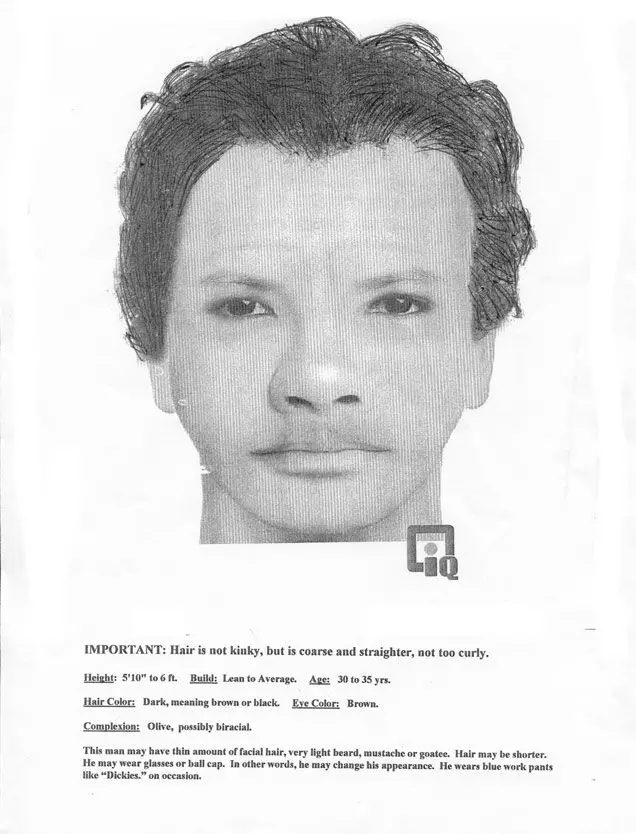 The final
exhibit is something of an historical artifact. On May 31, 2002,
Murray Pace was murdered in her Sharlo Avenue apartment. Early in
the investigation, Pace’s neighbors told police about a man
they had seen watching the victim’s apartment in the days and
hours preceding her murder. No composite sketch of this potential
person of interest (PPOI) was done. The four witnesses did however
work with a volunteer who, at her own expense, had purchased the
same software police use to develop their composites.
The final
exhibit is something of an historical artifact. On May 31, 2002,
Murray Pace was murdered in her Sharlo Avenue apartment. Early in
the investigation, Pace’s neighbors told police about a man
they had seen watching the victim’s apartment in the days and
hours preceding her murder. No composite sketch of this potential
person of interest (PPOI) was done. The four witnesses did however
work with a volunteer who, at her own expense, had purchased the
same software police use to develop their composites.